How to change the world?
- Imogen Israel
- Feb 15
- 4 min read

Comic which shows the difference between wanting change and wanting to change by Alan O'Rourke, source: https://www.flickr.com/photos/toddle_email_newsletters/21031243458/in/photostream/, licensed under CC-BY-2.0
Creativity, Subculture, and Social Change: Why Culture Moves Before Politics
Social movements rarely begin with policy documents. They begin with culture. Music, art and fashion provide the informal spaces where people can imagine life differently. Creativity lays the groundwork for social change by reshaping how people relate to one another and to the world around them. Long before political change becomes possible, cultural transformation has already taken place. It’s no surprise that new cultural scenes and music genres are a threat to the political status quo. They invite new social ideas into the mainstream, introducing alternative values, identities, and ways of living—shaping consumer behaviour, public opinion, and political attitudes in subtle but powerful ways.
Two Sides of the Same Process
Subcultures and social movements are however often treated as separate forces, despite being deeply intertwined. One aesthetic, entertaining and expressive, the other ideological, political and action driven. Both bring people together over the same underlying dissatisfaction with dominant systems, whether that be capitalism, war, social inequality or environmental destruction.
However, this relationship is fragile. Subcultures are frequently commodified, stripped of their political roots and repackaged as entertainment. Social movements, on the other hand, can become overly complex, inaccessible, or intimidating—alienating the very people they aim to mobilise. When this happens, creativity becomes disconnected from action, and political energy is absorbed into style rather than structural change.
Lessons from the 1960s: The Hippie Movement
The Hippie movement originated in the U.S but spread globally. Its ability to cultivate universal human themes of love, community, sexual liberation and a rejection of mainstream materialism meant that it could resonate so strongly around the world. Originating in response to the Vietnam war conflict as a counterculture to the traditional 9-5 life.
The anti-war movement gave rise to a subculture that embraced environmentalism, Eastern philosophy, and more communal ways of living. Yet by the 1970s, commercialisation diluted much of its political force. What began as resistance was absorbed into the marketplace, transformed into fashion, lifestyle branding, and nostalgia.

Hippies in Plaza Francia, Buenos Aires 1968. Unknown Author, licensed under PD-1996.
Punk: Defiance as Creative Power
In the mid-1970s, punk exploded in the UK, led by bands like the Sex Pistols and The Clash. Where hippies rejected mainstream culture through peace and spiritual withdrawal, punk rejected it through confrontation. Punk was explicitly political: anti-capitalist, anti-classist, anti-war, anti-establishment. Its embrace of DIY culture was a direct challenge to corporate control, recognizing that they could claim back their power from big, consumerist corporations.
Yet punk also exposed a recurring problem. Critics argued that many participants preferred the aesthetics of rebellion—music, drugs, fashion, and social identity—over sustained political action. Expression replaced organization. Energy that could have fueled systemic change was instead channeled into lifestyle and entertainment. Those in power, aware of this pattern, have repeatedly exploited it: allowing rebellion to exist as spectacle rather than threat.

Simon Bob Sinister preforming with Corrosion of Conformity at The Bridge, Toronto Canada by Erick Roy, licensed under CC-BY-SA-4.0.
Bridging the Gap Between Expression and Action
This raises an urgent question: how can we make social change more accessible, and subcultures more politically engaged? How do we ensure that future creative movements translate into meaningful action?
The answer may lie in participatory creativity—art forms that prioritize collective experience over individual consumption. Rather than passive audiences, they create active communities. Rather than polished products, they value process, collaboration, and empathy.
Jazz, Improvisation, and Collective Healing
The contemporary London jazz scene offers an intriguing example. Artists such as Laufey (not UK based) and Ezra Collective have brought elements of jazz into global the mainstream, with collaborations involving figures like Olivia Dean. Beneath this visibility lies a grassroots culture rooted in community, improvisation, and shared emotional experience.

Jazz - 'Discovery and Diffusion' by Matt Anderson, licensed under PD-US
Historically, people turn toward themes of peace, healing, and togetherness during periods of instability, with the hippie movement as an example. Today’s political climate—defined by financial crises, endless war, climate catastrophe, widening inequality, and the rise of populism—has created a collective sense of fear and dislocation.
As François Matarasso suggests, participatory art can help societies confront shared challenges by creating spaces where pain, empathy, and creativity coexist. Jazz jams and collaborative music-making embody this principle. They are anti-hierarchical, inclusive, and deeply human. Cultural organizations within the London jazz scene emphasize community, liberation, and political empowerment while blending traditional jazz techniques with funk, soul, rock, and electronic influences—reflecting both musical and social multiculturalism.
Creativity in the Age of AI
As artificial intelligence continues to reshape creative industries, the improvisational nature of jazz takes on new significance. Collective improvisation—the real-time emotional exchange between people—represents something technology cannot replicate. It is an assertion of human presence, vulnerability, and empathy.
This may be why such scenes are gaining traction. As society becomes more fragmented and mediated by technology, people increasingly crave authenticity, connection, and shared meaning. Culture once again becomes the testing ground for new ways of being together.
Culture First, Change Follows
If history teaches us anything, it is that social change does not begin with legislation—it begins with imagination. Subcultures shape the emotional landscape in which political action becomes possible. The challenge is not to suppress creativity in favour of activism, but to reconnect the two.
When culture and politics move together, creativity becomes more than expression. It becomes a rehearsal for a different world.
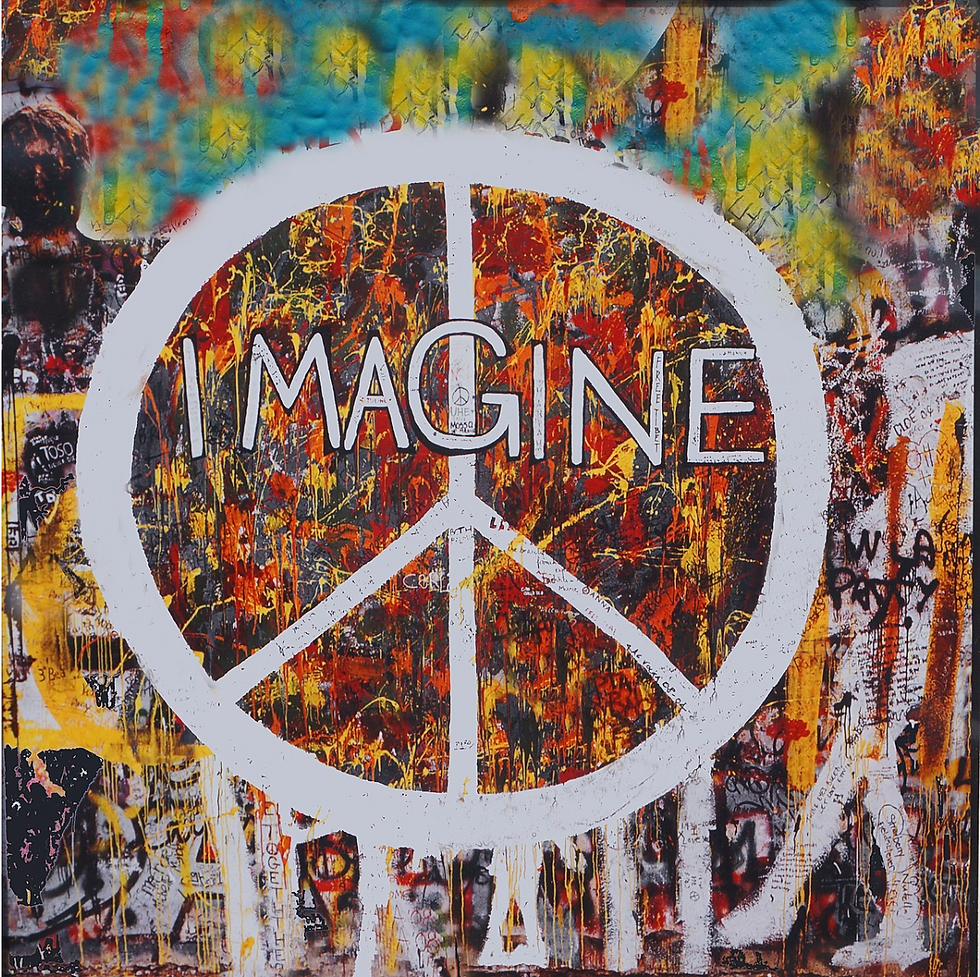
Peace sign with Imagine at the John Lennon Wall in Prague by Marko Kafé, licensed under CC-BY-SA-4.0


Comments